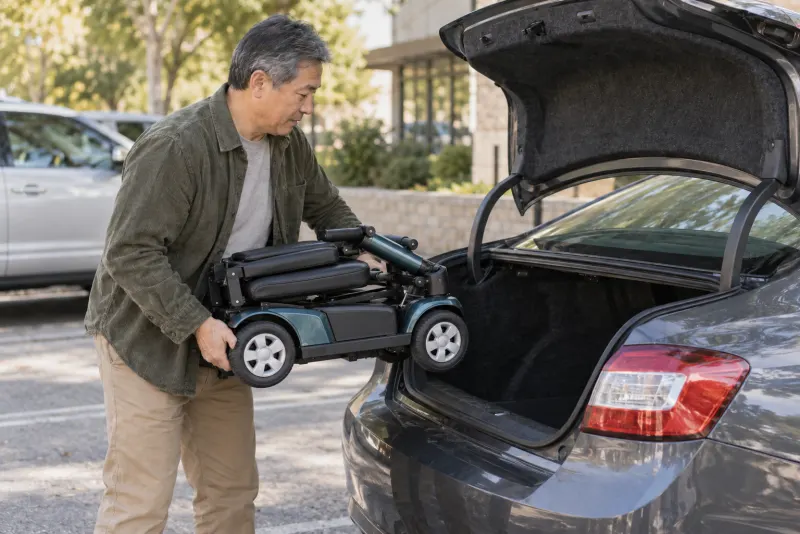
Folding scooters are built to come apart or fold so they fit in a car. That makes the comparison different from a full-size scooter. The questions that decide whether it works for you are practical: can someone lift it, does it fit your trunk, will it carry the user, and can it fly?
This guide lists the specs to compare and where to find them. It doesn't name or rank models, and it doesn't tell you which scooter suits a medical need. Ask your clinician or the supplier about that. Use this guide to read spec sheets with a clear list in hand.
Weight: the heaviest piece you'll lift
The total weight on a spec sheet is useful, but it isn't the number that matters most when you fold a scooter. What matters is the heaviest single piece someone has to lift into the car.
- Find the piece weights. Many folding scooters come apart into several pieces, or fold into one unit. The spec sheet or manual may list the weight of each piece, or of the heaviest one. If it doesn't, ask.
- Check whether the battery is included. Some listed weights include the battery, and some don't. Ask which, and how much the battery weighs on its own.
- Think about who lifts it. Is it the user, a partner, or a helper who isn't always there? Ask the supplier for a demonstration before you commit, and try the lift yourself if you can.
FDA classifies motorized three-wheeled vehicles as Class II devices and lists the international standards it recognizes for them [1]. One covers how to determine overall dimensions, mass and maneuvering space [1]. When you compare two models, ask whether their weights and dimensions were measured the same way.
Folded size against your trunk
A folded scooter has to fit the car you actually drive.
- Measure your trunk. Write down the opening height and width, the depth of the floor, and the height of the lip you lift over. Do the same for the back seat if that's where it would go.
- Compare the folded dimensions. Look for folded length, width and height on the spec sheet. Make sure all three fit, with the scooter in the position it folds into.
- Check the unfolded size too. Your doorways, hallways and elevator need to fit the open scooter, so compare its overall length and width with the narrowest place it has to pass.
- Ask how it folds. Does it fold in one motion, or come apart into pieces? Are there latches or levers that take hand strength? Ask the supplier to show you.
Weight capacity, turning and clearance
Weight capacity. Every scooter has a maximum user weight. Compare it with the user's weight, plus anything carried on the scooter, and ask the supplier how bags or a basket count against it.
Turning. The spec sheet may list a turning radius. Compare it with your tightest turn at home, such as a hallway corner or the space beside a bed. The dimensions standard on FDA's list also covers maneuvering space [1], so ask whether the figure was measured to it.
Ground clearance and obstacles. Check the listed ground clearance and the obstacle height the scooter can climb, then think about your curbs, thresholds, gravel and grass. FDA's list of recognized standards for these vehicles also includes one for the obstacle-climbing ability of electrically powered wheelchairs [1]. Ask the supplier which surfaces the manufacturer says the scooter is designed for.
Speed. Look for the maximum speed and whether it can be limited. FDA's list also includes a standard for determining the maximum speed of electrically powered wheelchairs [1].
Range claims and how they're measured
Range is the distance a scooter can travel on a full charge. It's one of the easiest numbers to compare, and one of the easiest to misread.
FDA's list for these vehicles includes an international standard, ISO 7176-4, covering the energy consumption of electric wheelchairs and scooters "for determination of theoretical distance range" [1]. The word "theoretical" is the clue. A test figure comes from set conditions. Your range will depend on your own hills, surfaces, stops and use.
When you compare range claims:
- Ask how the figure was measured, and whether both models were tested the same way.
- Ask whether the range quoted is for the battery the scooter comes with, or for an optional larger one.
- Ask how long a full charge takes, and whether a spare battery is available.
Battery type and flying
If you plan to fly, the battery may decide which scooter you can take. Find three facts on the spec sheet or the battery label: the battery chemistry (lithium-ion, or a sealed or other type), its watt-hour (Wh) rating, and whether it comes out of the scooter.
- Watt hours. A lithium-ion battery's Wh rating should be marked on the battery. If it isn't, you can work it out by multiplying volts by amp hours [2].
- Tell the airline. For electric wheelchairs and mobility scooters, the FAA says the passenger must tell the airline where the battery is on the device [2].
- Removed lithium-ion batteries. If the lithium-ion battery is removed, it's limited to 300 Wh and must go in carry-on baggage only. You can bring one spare up to 300 Wh, or two spares up to 160 Wh each, in carry-on only [2].
- Installed batteries. A device with a lithium-ion battery installed and protected by design, and not removed, must be checked, not carried on [2].
- Other battery types. For scooters with spillable, non-spillable or dry batteries, the FAA says to contact your airline, because advance arrangements and extra check-in time may be needed [2].
Airline rules under federal law also shape the trip. Airlines must accept a passenger's battery-powered mobility device, including the battery, as checked baggage when cargo-hold size and aircraft airworthiness allow [3]. An airline may ask you to check in one hour before the general check-in time [3]. If the battery is labeled by the manufacturer as non-spillable, the airline must not require it to be removed and packaged separately [3]. You may give the airline written directions for taking the device apart and putting it back together, and the airline must follow them as far as it can [4]. Keep a printed copy of the folding steps from the owner's manual with the scooter.
The FAA notes that TSA, individual airline and international rules may be more restrictive [2], so check with your airline before you book.
Where to find these numbers
Get every figure from the manufacturer's spec sheet and owner's manual for the exact model, not from a store listing or an ad. FDA's recognized standards for these vehicles include one on information disclosure, documentation and labeling [1], so ask the supplier for the full documentation. Check that the spec sheet lists heaviest-piece weight, folded dimensions, weight capacity, range, turning radius, ground clearance, battery type and Wh rating. Write down anything missing and ask about it.
If Medicare may pay, ask before you shop. Medicare covers scooters only when they're medically necessary, and you need a face-to-face examination and a written prescription from a treating provider first [5]. Ask your provider and supplier what that means for the model you're considering.
Our renting vs buying guide covers whether to rent first, and our rent-or-buy tool compares the quotes you collect.
Where to go next
Use our supplier search to find scooter suppliers near you, and ask them for the spec sheet and manual of any model you're considering. For an overview of scooter types, read our scooters overview.